Viberg's BCT Stitchdown Service Boot in C F Stead's Husk Oiled Culatta
Jan 27, 2026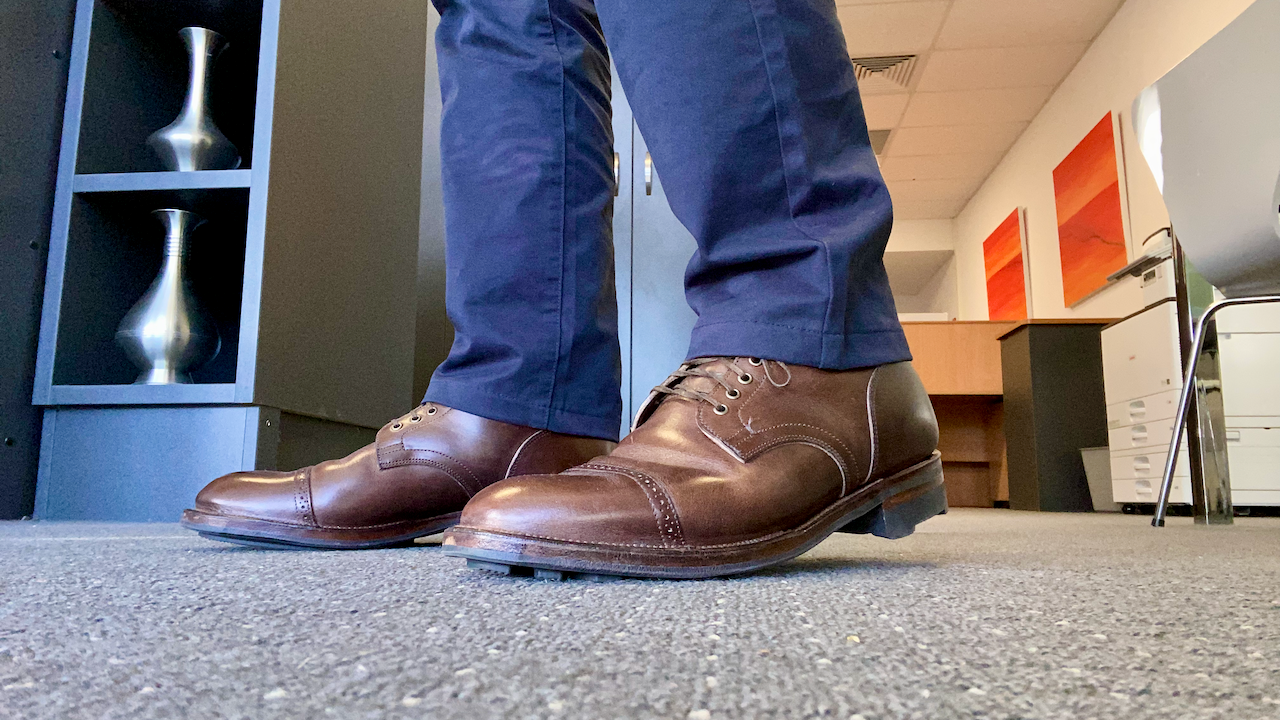
“Husk is a rich brown colour with burgundy undertones.” Really?
Is this a tough Pacific North West Boot so well made you wouldn’t take it out for a hike through mud and rocks?
Intriguing. Let me answer both these questions.
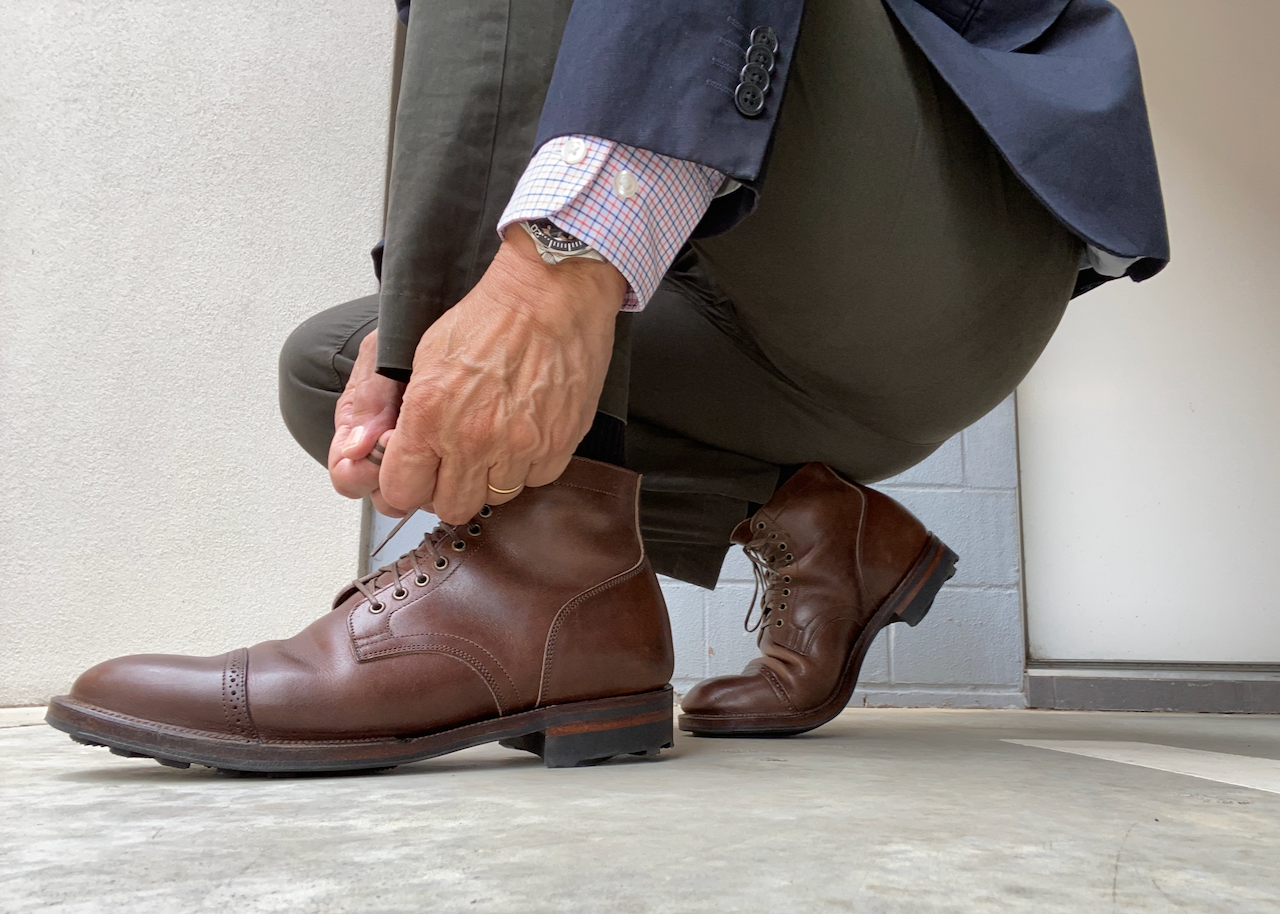
This Viberg Stitchdown Service Boot, on their most popular last, the 2030 last or “foot” shape, is built using leather from the famous English Tannery Charles F Stead. It is called Oiled Culatta, and as the marketing documents describe it, it’s a rich brown leather, but supposedly also rich with burgundy undertones. Frankly, I find it hard to discern any burgundy-ness. It's a mid-brown leather reminiscent of milk chocolate.
I’ll go into more detail about Culatta when I get to construction.
The Viberg service boot is a classic military pattern, in this case, revived from World War 2 Canadian army boots. It has a lower, five-inch shaft, when most service boots are nearer 6 inches. The shape, flat block heel, and the open Derby lace facings are all classic service boot patterns, and in this case has what Viberg calls a BCT or Brogue Cap Toe. We’ll go into that when I go through the construction.
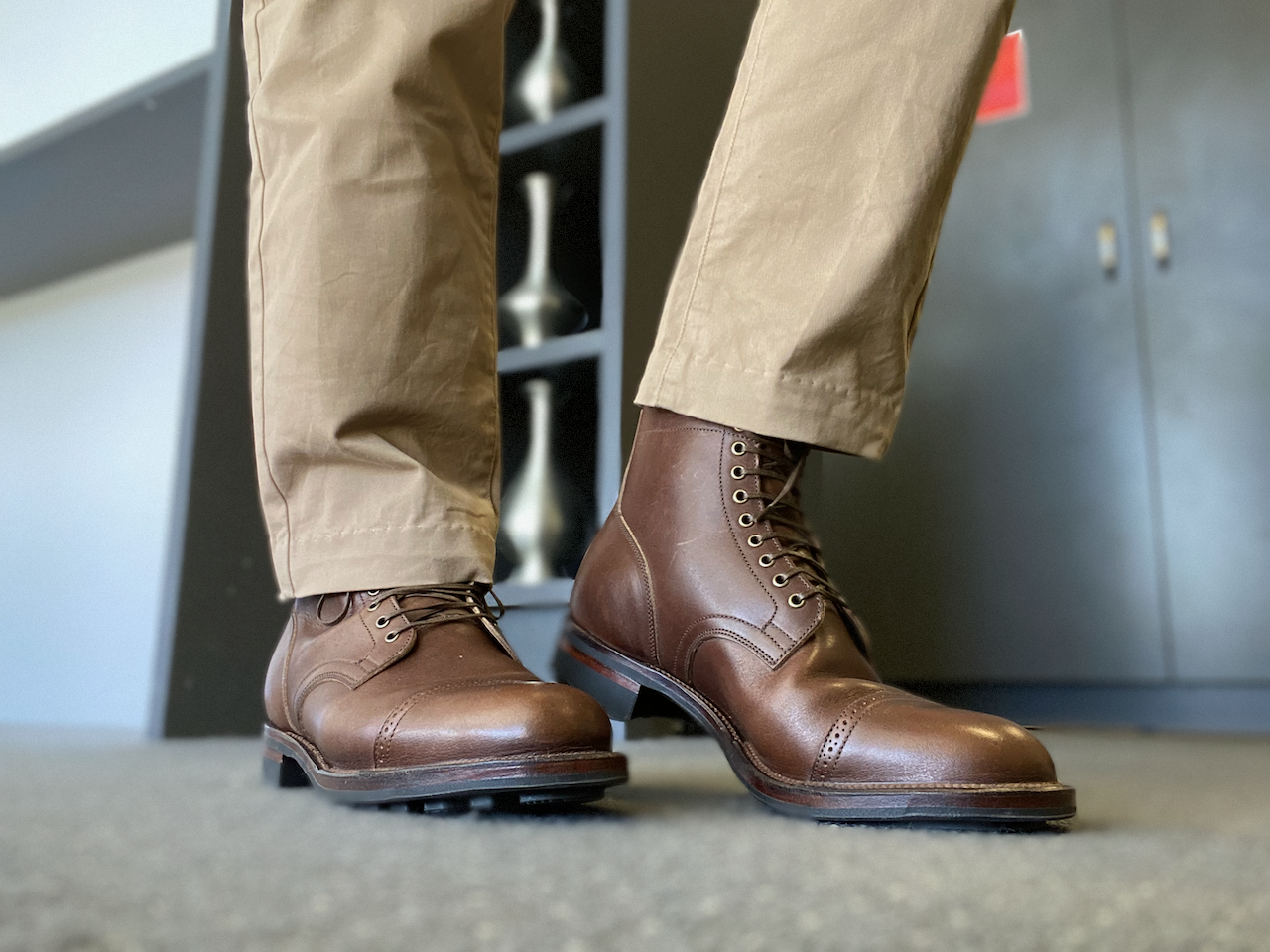
It’s certainly a stylish boot, especially in this 2030 last that offers a wide forefoot that narrows into a rounded almond-shaped toe. In profile, this version has a structured toe box, and so has quite a rounded and higher-volume profile. In this last and in this smooth-grained brown colour, it can be worn quite dressy.
I have got away with a suit, but honestly, it does look like I wore appropriate shoes but forgot to polish them, and so it looks a little unkempt. So, to be honest, I think the best look for this is a dressed-down business casual, like I’ve worn it with dark green chinos, a chambray shirt, and a blazer. You can also mix it up with jeans and a sports coat - or just tan or sand coloured chinos and yeah, a sports coat.


I think you can wear it rugged - I took it hiking in jeans, a T-shirt and a Huckberry Waxed Trucker Jacket.

But hey, that use could answer my second question: "is this too finely made to wear rugged?" I’ll answer that at the end, but a look at the brand might give you a clue.
Viberg is a Canadian company founded in 1931, and has been owned and run by the same family ever since. It is now in the hands of the third generation of the Viberg family. Originally founded in Saskatchewan, making boots for farmers, during the war, Viberg made boots for the Canadian military - boots that looked very similar yet different from today’s service boot.
After the war, Viberg moved to Prince George, British Columbia.
Where Saskatchewan was all agriculture in the 1930s and 40s, British Columbia was all logging, so guess what, Viberg used their experience of making hard-working ankle boots to make boots for the logging industry. Viberg settled into making tough work boots, and moving to Victoria in British Columbia, where it remains to this day, became a popular Pacific Northwest bootmaker of work boots. As an aside, some Americans don’t consider Viberg part of the PNW scene since they’re across the border. They think they’re sort of Pacific South West.
For those not in the know, the Pacific Northwest is that part of America that sits on the Pacific Ocean and is in the Northwest of the American continent, primarily involving the US states of Washington and Oregon. To us in Australia, anywhere northwest of Texas is Pacific North West.
Pacific Northwest bootmakers are an important subset of American bootmakers - famed for making tough and sturdy workboots for the logging and supportive industries, bush firefighters, and so on, and in modern times, more general workboots for manual workers, builders and so on. Check out my review of the White’s MP boot.
Viberg, despite being across the border, falls into this niche.
But here’s where it gets interesting.
As we all know, in the mid-2000s, Asia, and in particular Japan, started to take on the American Heritage trend. From what I can see, in boots, it started with Red Wing, which, even to this day, makes models exclusively for the Japanese and other Asian markets. The Japanese economy was strong at the time, and the Japanese travelled all over the world on holidays and mass wedding tours - yeah, that was a thing - so they brought home well-made fashion articles, and the younger set brought home Americana fashion, including jeans and boots.
Brett Viberg, the third generation, spent a lot of time there and got Viberg to start making Japanese-market focused boots, and then in the late 2000s, really hit on the winner that is the Viberg Stitchdown Service Boot today. Viberg pulled out their original military boots, updated them with some British lasts, and the Viberg Service Boot was reborn.
It is not hyperbole to say that Viberg started the service boot trend that brands like Thursday, Grant Stone, Oak Street Bootmakers, and Parkhurst are on today.
Which is a good time to look at the construction and see how a tough boot with military and workbook origins can be made finely.
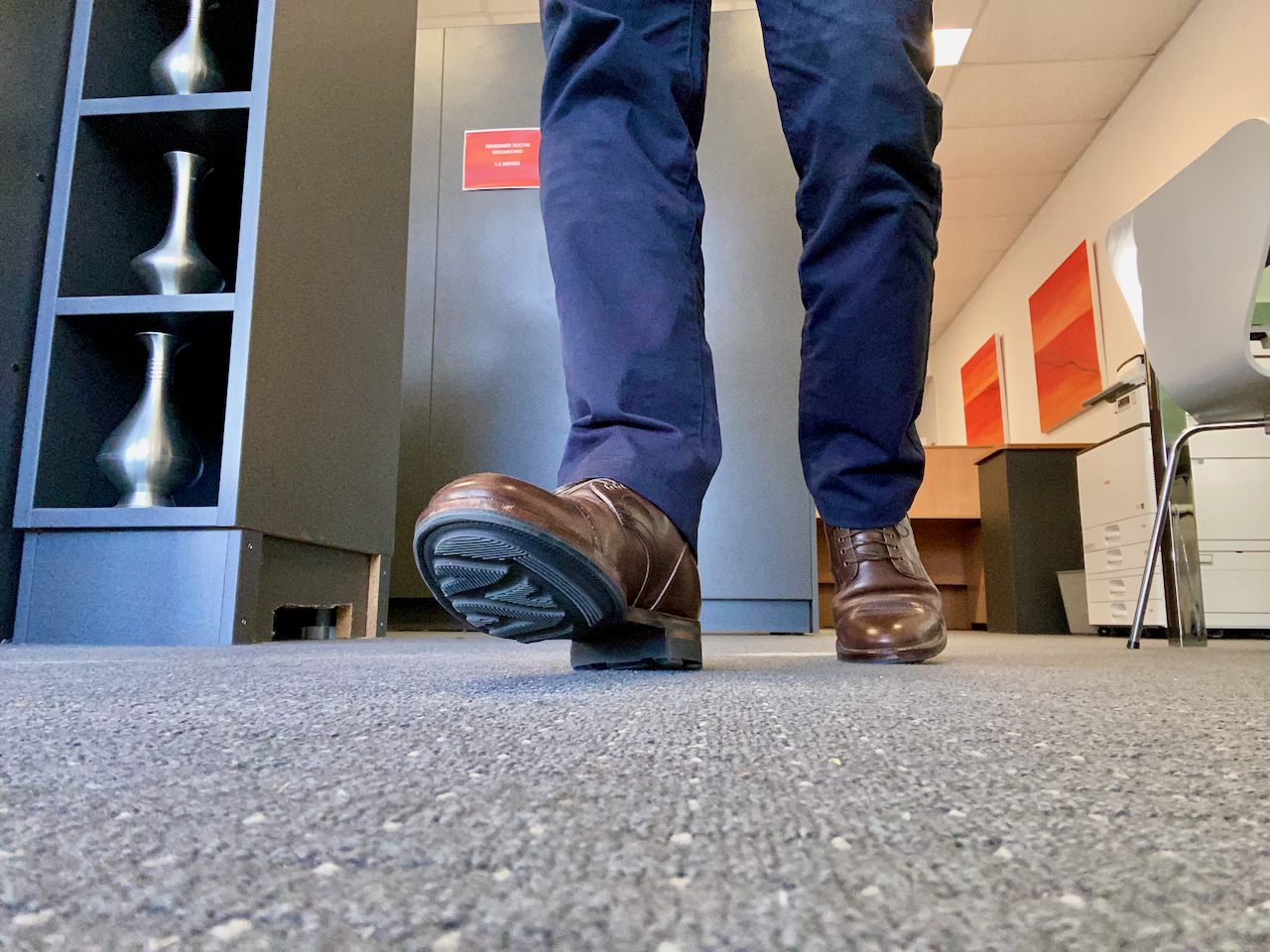
This model sits on a Ridgeway sole, which is one of my personal favourites. Ridgeway is made by the same people who make the ubiquitous Dainite, studded sole, except that in the Ridgeway, they took their inspiration from the line of ridges making up the prehistoric Ridgeway trail in England, running from Wiltshire to Buckinghamshire. You can see the designed swirls looking like the ridge lines, which produce a pretty good grip under most conditions, and being made of a softer rubber, also helps with a better grip. The lugs are low in profile, so from the side, they can pass as dressy or even formal shoes.
The soles are connected to the uppers using the stitch-down method of boot construction. In stitchdown, the uppers are stretched out over the last in the lasting process, and then flared outwards and stitched down to the sole. In this case, it’s an extremely fine and neat double stitch down - the first stitches the uppers to the midsole, and then the second stitches the uppers, through the midsole, to the outsole. That’s why you see two stitches on top, and only one stitch underneath.
People who like Goodyear Welting, where the uppers are turned inwards and stitched through a welt to the insole as well as through the welt to the outsole, say that the Goodyear Welt method is more water resistant. But people who swear by the stitchdown method say that this is just as good. In fact, the way the uppers flare outwards wicks the moisture away off the boot.
Honestly, I think it’s six of one and a half dozen of the other. I’ve walked through pouring tropical storms in both, I’ve hiked through muddy tracks in both, and I’ve even run across shallow streams in both, and unless you actually stand in a deep puddle, I’ve never had moisture penetrate either.
The midsole is veg-tanned leather, and there is some controversy inside the boot. Many people argue that the mark of a really well-built boot is the use of leather everywhere, and inside, where the cavity in the well of the boot has to be filled, it should be a natural material that adapts and moulds to the shape of your foot. Meaning, the use of a natural cork filler is expected.
There was a cobbler tear-down of a Viberg service boot on YouTube, where a foam filler was revealed. Foam is used a lot these days, instead of cork, as a modern material because it’s more immediately wearable, but on a heritage quality and expensive boot like this, it’s frowned upon. As it turns out, apparently that boot was a collaboration and in some collaborations, due to the other partner requesting some changes, foam was used. On their standard boots, Viberg assures me that they use cork fillers.
Moving on up, the insole is leather, and there is a heel-to-arch leather comfort liner with a lightly padded foam padding under the heel. Inside the boot, the vamp and the tongue are lined with a soft kip leather.
What is kip leather? Kip is the untanned hide of a young or small animal, such as a calf, lamb, or young goat. Kip leather is a reasonably new introduction to the market and is especially used to create high-end gloves. So, as lining, it’s nice and soft.
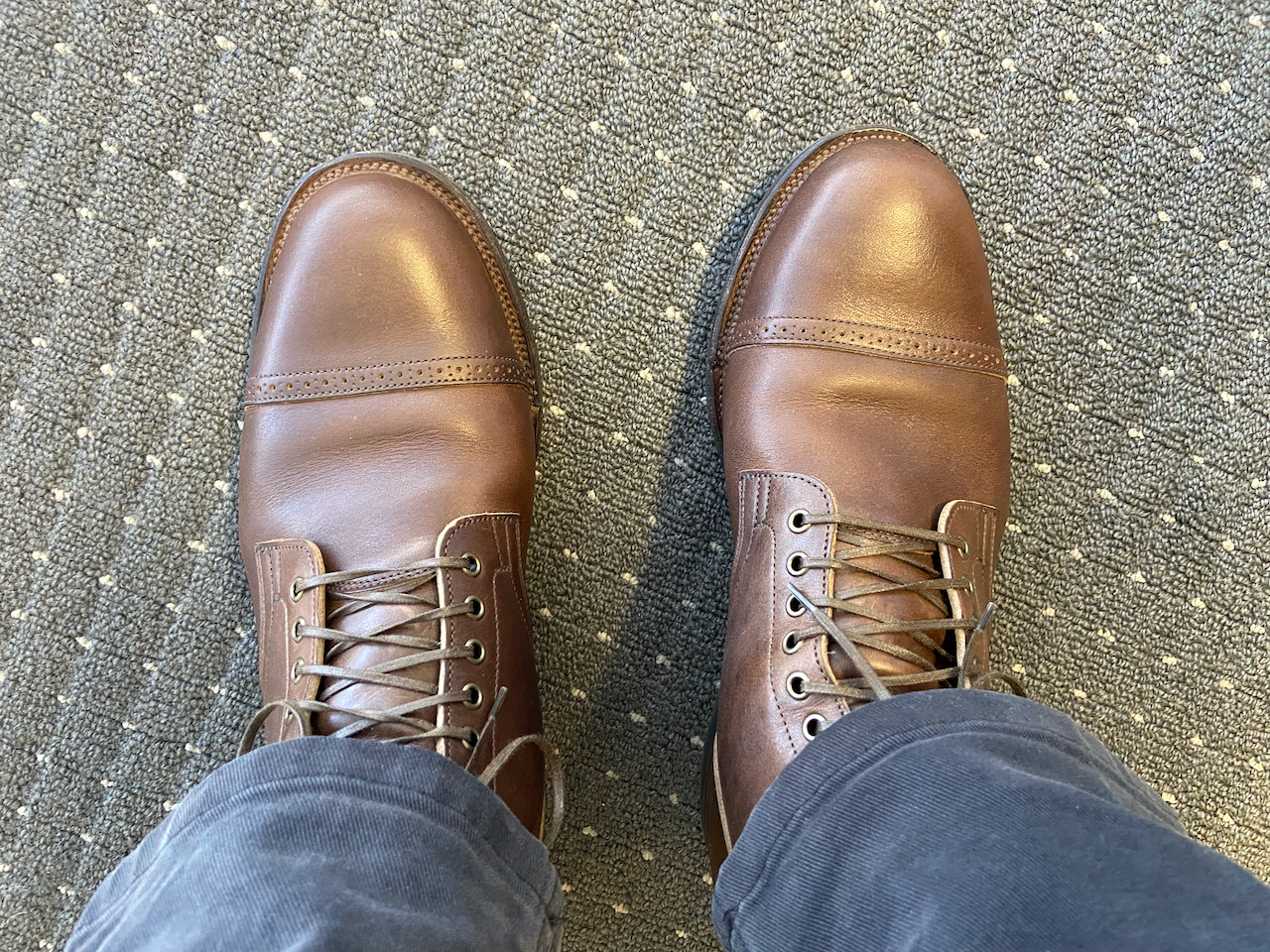
Outside the boot, the uppers are a leather called Oiled Culatta, from Charles F Stead in England. Stead is an old and famous tannery, especially renowned for their suedes, and in recent years, their exotic leathers like Kudu and Moose.
People think Culatta is a horse hide or horse rump, but this is not necessarily so. "Culatta" merely means the back part, and so it could be the back part of a horse or a steer. In this case, it is from the rear bend and belly area of the steer. The website describes it as the most premium selection of the hide. They say that this section has a high oil content, giving the leather a soft metallic shine that will later develop into a lustrous patina with more age. On top of that, the high oil content provides greater weather resistance.
And on top of that, it’s also an eco-tannage that is certified biodegradable.
The colour is called “Husk”, and I have no idea what husks have this colour? Coconut?
It’s definitely brown - in the mid range, and if it does have Burgundy overtones, I can't see it. It’s like the “is she wearing a blue dress or a white dress?” thing.
It is "oiled" Culatta, meaning, I think, they pack it with oils, so it does have some pull-up, and you can see the oils move around in there. In the hand, it’s quite a sturdy and firm leather, which is why I think people who feel culatta from a steer, will mistake it for horse hide, which tends to be firmer.
If you look closely, it has a very fine but irregular and attractive grain. Like horse hide, or particularly horse rump, it rolls rather than creases and any creases are really fine, crystalline lines.
The pattern pieces are the typical military style - there’s a one-piece backstay that curves around the sides of the heel, small quarters so the lace facings stay quite wide apart when you lace up, and a brogue pattern cap toe.
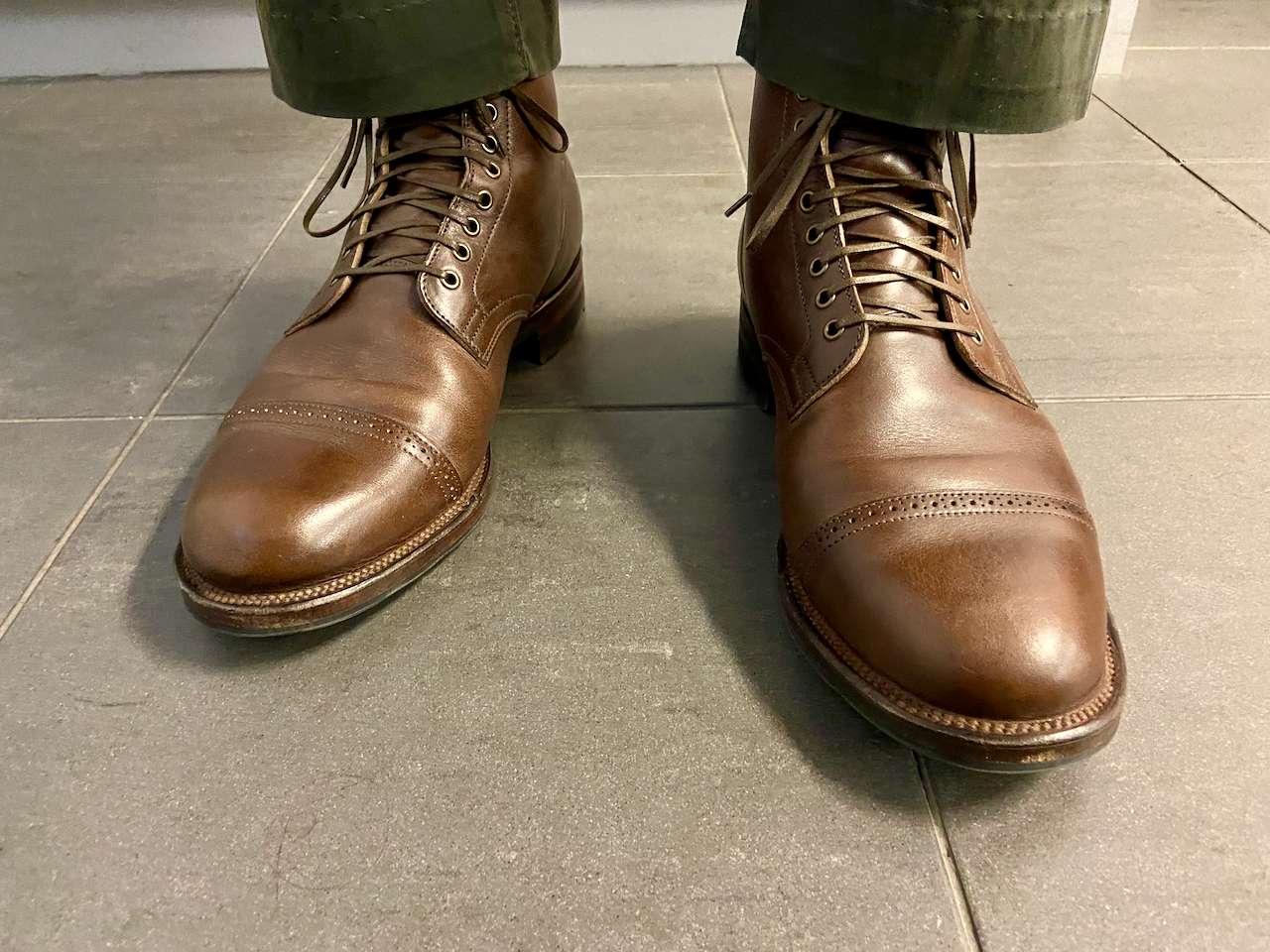
The BCT or Brogue Cap Toe nomenclature refers to the line of hand-punched holes - decorative rather than functional - on the edge of the toe cap. The toe cap isn’t a real second-layer-of-leather toe cap piece. It’s a toe cap piece sewn onto a short vamp piece.
Structuring in the toe is light - I think it’s celastic, and structuring in the external heel counter is pretty stiff. The heel counter is veg-tanned leather, sewn in between the backstay and the internal structure of the boot, which gives a firmer and better feel when your heel is cupped in there.
The tongue is not gusseted, which surprises me for what is essentially supposed to be an outdoor and rugged boot. I think technically, that can be a moisture weak-point if you stand in or splash water for any length of time above the eyelet level. But it’s lined and the culatta is stiff enough not to slip to one side as many of my ungussetted-tongue boots do.
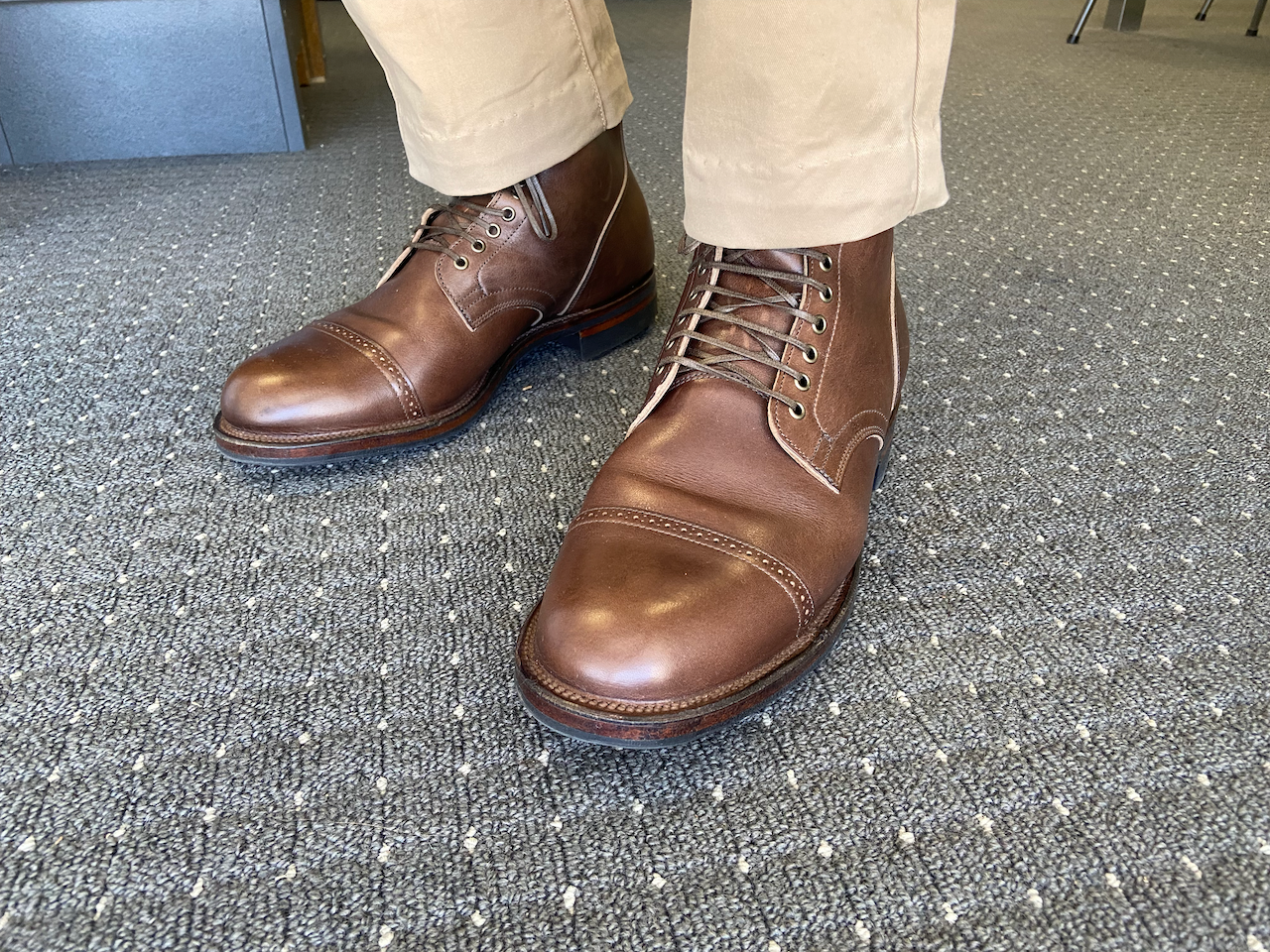
The lace facings are reinforced with a second piece of Culatta leather, as is the collar, and the hardware is nine antiqued brass, small eyelets. There are no speed hooks, which makes this - even in my very forgiving eyes - a difficult boot to do up, especially when they supply them with really skinny Viberg laces. My fingers are just not delicate enough to lace this up quickly.
But strangely enough, when laced up, you see why the design choice was to have a lot of small eyelets and these skinny laces - it really does balance the look.
I think it’s the complete package. The materials used are top of the line. The way they are put together represents the best QC in my opinion, not a stitch wrong, not a piece of leather either cut or stitched wonky. The stitching in the stitchdown and on the pieces of leather is so fine you’d think this was stitched by someone who makes bespoke suits for a living. The spacing between the double stitching is so close I can hardly measure the gap. The stitch density - how many stitches in an inch - is so dense and fine that I can hardly count. The stitching on the stitchdown is so close to the edge that if the man or woman who stitched this doesn’t wear coke bottle glasses, I’ll be surprised.
Now, with all this fine work, you want to take care of this, so to leather care. Let’s not be precious, it is steer hide, so basically it’s the usual conditioning and if you want, polish.
I can’t find any specific instructions on the Stead website - what a shemozzle to the public that website is - nor can I find any direct instructions from the Viberg website. But Viberg does use Venetian Shoe Cream a lot, and as with all Viberg service boots, they also provided a small jar of VSC - so there’s your clue.
Brush the boot regularly. That’s almost a non sequiter, because the most important thing with any leather is to keep loose dirt and grit off it, or that will cause some damage over time. If it does need cleaning, like all smooth-grain leathers, wipe it down with a damp cloth or if it really has been through a muddy track or somehow got greasy dirt all over it, I don’t think a good saddle soap can go wrong.
Conditioning is another obvious “to-do” especially after it’s been cleaned, or when it starts to dry. Being an oil-packed leather, that’s not too often, maybe a couple to four times a year, depending on your use of these boots.
After conditioning, I like shining up these boots - to a degree. I was told by Trickers that one of their tricks for their smooth-grain boots was to condition, and then dab them with neutral soft wax polish as a protective cover, using a slightly damp sponge, let it dry to a haze, and then brush to a sheen.
As for sizing, fit and comfort, Viberg uses the UK sizing convention.
I read everywhere on forums, Americans commenting that you have to take a whole size down.
Well, this is not strictly true. It’s just that the UK sizing convention is one number down from the US sizing convention. By that I mean that if I measure a US size 8 and a half on the Brannock Device, in the UK, I’d usually look for a UK size 7 and a half. The shoes measure the same; they just use different numbers to standardise their sizing of that measurement.
Confused yet? Well, you will be when I bring up the subject of being "true to size". Bear in mind, your feet will always measure the same length in inches or centimetres. It is the different sizing conventions that allocate a number to them, and that numnber is different depending on if you are using the US, UK or European sizing conventions.
However, many American boot makers make their boots large, so while I measure US 8 and a half ("true to size"), I usually fit into US size 8 boots, because most US boot brands call their size 8 and a half measuring boots an "8". But some makers make their boots true to size, meaning when they say "8", they actually mean "8", so that if I measure 8 and a half, I must buy their boots in 8 and a half.
Viberg make their boots true to size, in the UK sizing convention. This means that because I measure as a US 8 and a half, I am sized by Viberg as 7 and a half.
Don’t get me started on European sizing.
With that settled, let’s turn to how they fit.
This 2030 last is pretty good for my shaped feet. Some people complain that because of the almond toe, the big toe area curves in a bit too much and squeezes their big toe in. I haven’t found that. To me, the last is snug in the heel and just right at the ball, and also just right at the toe.
Out of the box, these are stiff.
The stiff leather midsole and the stiff Ridgeway are hard to bend at first. The uppers leather is definitely firm at first, and that heel cup didn’t want to go anywhere that my feet wanted to go. But now, after breaking in, with a couple of hundred hours of wear, they really have melded to the 3-dimensional shape of my feet and feel supportive and comfortable.
So, are they finished too finely to wear out bush bashing?
Should you wear these boots, as well-made as they are delicately and finely finished, out on a hike over rough terrain, rocks that can scratch, and through water and mud?
Well, I have! Go see my comparison between these and the Whites MP Boot on YouTube. I took both on a hiking holiday in the winter, and I took this pair through some tough stuff. OK, I must admit, I had to do a mind jump because it first seemed a silly thing to do. My wife saw me put them on before we went on a hike, and she sai,d “Really?”
But putting myself in a different mindset and going out there, they took it - no problem at all.
So yeah, as much as they look like something you’d wear only for fine, city-based locations, go take them out there, they’ll be fine!
Finally, what about value? Because these are not cheap boots, as befits the experience Viberg brings to the game, the way they are put together, and the quality materials throughout. When I bought them in January of 2023, they were listed on the Viberg website for US$940.
Was that too much?
Value is a personal thing, isn’t it? Sure, you base it on how long it lasts - well, check - and what it’s made of and how it’s made - yeah, check, check - but you also base value on how you like it, how it makes you feel. In many ways, when I put these on, I feel like some people feel when they know they can afford and drive a Mercedes. You know what I mean? I’ve arrived.
To me, they’re worth it.
To you? It’s not about the price or the quality - how are YOU going to feel wearing this?
Stay connected with news and updates!
Join our mailing list to receive the latest news and updates from Bootlosophy.
Don't worry, your information will not be shared.
We hate SPAM. We will never sell your information, for any reason.
